What is a blockchain? A plain-English guide based on NIST's overview
How a blockchain works, block by block: hashes, signatures, consensus, permissionless vs permissioned networks, and the limits that marketing usually leaves out.
Figures checked against 3 official and primary sources on . See the sources · How we check
Key points
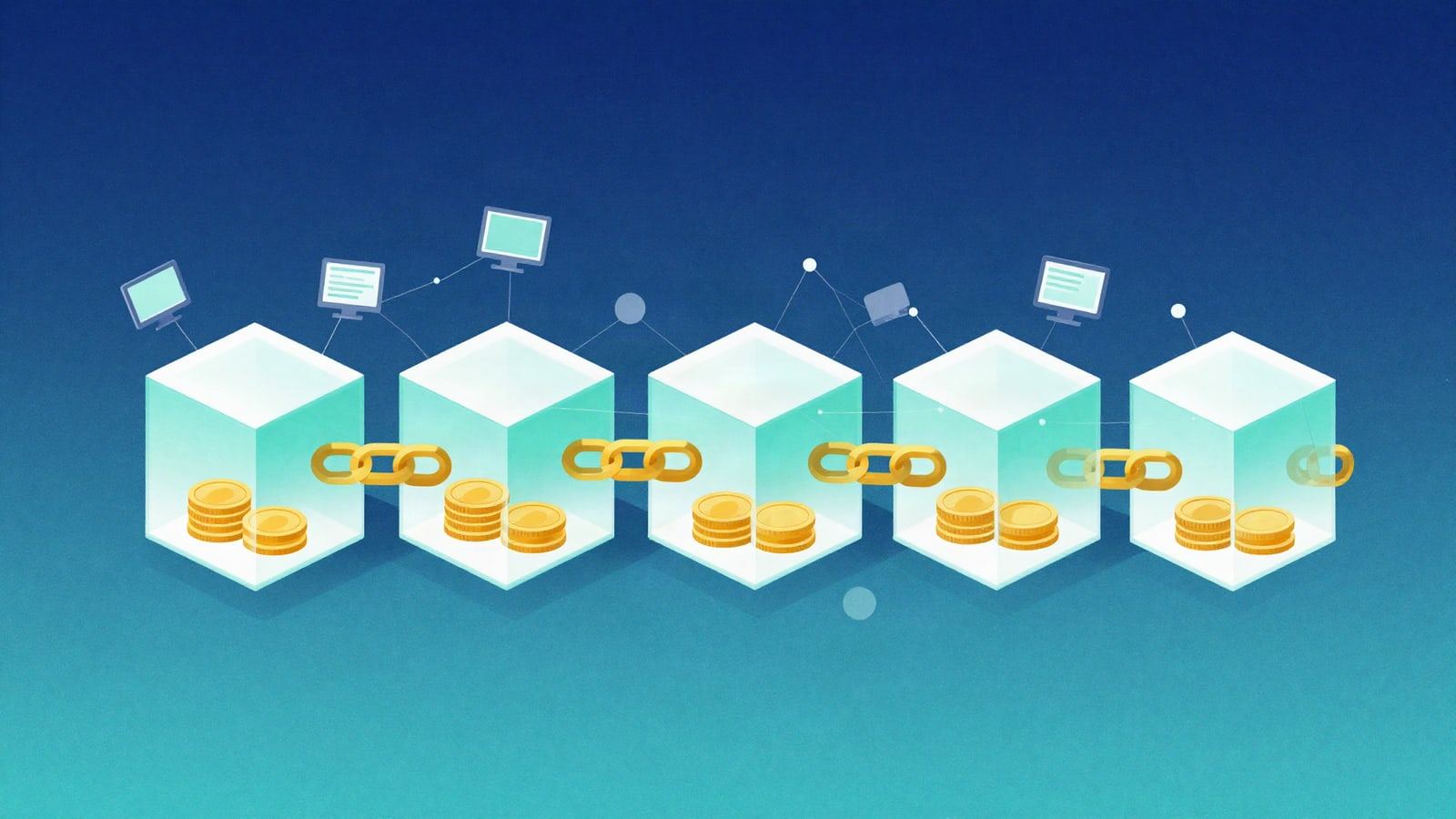
- A blockchain is a shared ledger of signed transactions, grouped into blocks, where each block is cryptographically linked to the one before.
- That linking makes it tamper evident, and as blocks pile up, tamper resistant, but NIST stresses it isn't strictly immutable.
- Permissionless blockchains (like Bitcoin) let anyone participate; permissioned ones limit who can.
- Networks agree on new blocks through a consensus model, such as proof of work or proof of stake.
- Blockchains can't check facts about the real world on their own (the "oracle problem").
In this guide
“Blockchain” is one of those words that’s used everywhere and explained almost nowhere. This guide explains it from a dependable source: NISTIR 8202, Blockchain Technology Overview, published by the US National Institute of Standards and Technology. It’s written for non-specialists and is refreshingly free of hype.
The one-paragraph definition
NIST’s overview defines blockchains this way:
Blockchains are tamper evident and tamper resistant digital ledgers implemented in a distributed fashion (i.e., without a central repository) and usually without a central authority (i.e., a bank, company, or government).
In practice, a blockchain lets a community of users record transactions in a shared ledger, such that, under normal operation, no transaction can be changed once it’s published.
How it works, step by step
1. Transactions are signed
Each transaction records what happened, for example “address A sends 0.1 coins to address B”. It’s digitally signed by the user who submits it, using their private key. The signature proves the transaction came from whoever controls that key, without revealing the key.
What a hash looks like
A hash function turns any input into a fixed-length fingerprint. NIST’s overview uses SHA-256, the function behind many blockchains, including bitcoin. Its examples show how a tiny change produces a completely different result:
| Input | SHA-256 digest (first 16 characters) |
|---|---|
1 |
6b86b273ff34fce1… |
2 |
d4735e3a265e16ee… |
Hello, World! |
dffd6021bb2bd5b0… |
NIST lists three properties that make this useful:
- Preimage resistance: you can’t work backwards from a digest to the input.
- Second preimage resistance: given one input, you can’t find another that produces the same digest.
- Collision resistance: you can’t find any two inputs with the same digest. NIST estimates that finding a SHA-256 collision would take about 2^128 attempts. At the whole bitcoin network’s 2015 hash rate, that’s roughly 36 trillion years, against a universe about 13.7 billion years old.
2. Transactions are grouped into blocks
Pending transactions are collected into a block. NIST describes each block as having two parts:
- A block header, with metadata about the block.
- Block data, with a set of transactions and related data.
3. Each block points to the previous one
Every block header, except the very first block, contains a cryptographic link to the previous block’s header. That link is a hash: a short fingerprint calculated from the data. Change even one character in an old block and its hash changes, which breaks the link to every block after it.
That’s what makes the ledger tamper evident: tampering shows.
4. The network agrees on the next block
Many independent computers (nodes) keep copies of the ledger. They need a way to agree on which block comes next. That’s the consensus model:
- Proof of work: participants compete to solve a computational puzzle; the winner adds the block. Bitcoin uses this. Its original white paper describes timestamping transactions “into an ongoing chain of hash-based proof-of-work”.
- Proof of stake: participants lock up the network’s coins as a security deposit and are chosen to propose and confirm blocks. Ethereum switched to proof of stake on 15 September 2022 (“The Merge”), which, according to ethereum.org, reduced its energy consumption by about 99.95%.
NIST lists other models, such as round robin and proof of authority, used mostly in permissioned networks.
When two blocks arrive at once
On busy open networks, two nodes sometimes publish a valid block at almost the same moment, with slightly different transactions. NIST explains what happens:
- For a short while, different parts of the network see different versions of the chain. Neither is “wrong”; each node used the information it had.
- The conflict is usually resolved quickly: when the next block is published on top of one version, the network adopts that longer chain.
- The block that lost out becomes an orphaned block. Any of its transactions that aren’t in the winning chain go back to the pool of pending transactions, to be included later.
This is why a payment in the newest block isn’t treated as final straight away. See block explorers.
5. More blocks make old ones harder to change
As new blocks are added on top, older blocks become more difficult to modify, because changing one would mean redoing the work, or out-staking the network, for every block after it. That’s the tamper resistance.
Permissionless vs permissioned
NIST divides blockchains into two broad families:
| Permissionless | Permissioned | |
|---|---|---|
| Who can read and write | Anyone, without authorization | Only specific people or organizations |
| Typical examples | Bitcoin, Ethereum | Business and consortium networks |
| How trust is achieved | Open consensus (proof of work or stake) | Known, approved participants |
| Native cryptocurrency | Usually, to reward participants | Not necessarily |
When people talk about “crypto”, they almost always mean permissionless blockchains.
What blockchains do well
- Shared record without a central keeper: participants who don’t fully trust each other can still agree on one history.
- Transparency: on public blockchains, anyone can check the ledger.
- Resilience: with many copies of the ledger, there’s no single server to switch off.
The limits that marketing leaves out
NIST’s report has a whole chapter on “limitations and misconceptions”. The key points:
- Not strictly immutable. NIST says blockchains are tamper evident and tamper resistant, but “cannot be considered completely immutable”. The most recent blocks can be replaced if a longer competing chain appears, which is why users wait for several more blocks before treating a transaction as final. On smaller networks, an attacker controlling more than half of the block-producing resources could carry out a 51% attack.
- The oracle problem. Blockchains work well with data inside their own system, but they can’t verify facts about the real world. If someone records false information, the blockchain will faithfully preserve it.
- Governance is human. Changes to a blockchain’s rules are decided by people: developers, node operators and users. Disagreements can split a network into two (a hard fork).
- Blockchains don’t really “die”. NIST notes that when a network shuts down, some nodes may keep running indefinitely, which matters for data you’d want deleted.
- “Trustless” isn’t quite right. NIST notes that even without a trusted third party, users still trust the cryptography, the software developers, any smart contracts they use, and that no group secretly controls more than half of the block-producing power.
- You may not need one. NIST reviews several “do you need a blockchain?” guides and observes that, in one decision flowchart it examined, most paths lead to “no”. Its advice to organizations is to examine whether existing technologies could solve the problem better.
- Your security depends on your keys. The blockchain can be secure while your account isn’t. Whoever controls the private key controls the coins.
Why this matters if you own crypto
Three practical consequences follow from how blockchains work:
- Transactions can’t be undone. There’s no bank to call. Send to the wrong address, or to a scammer, and the funds are usually gone. See crypto scams and where to report them.
- Fees pay the network. Every transaction pays the people who add blocks, so fees rise when the network is busy. See exchange fees explained.
- Keys are everything. Your seed phrase is the only way to recover a self-custody wallet.
Next in the basics: what is bitcoin? and what is Ethereum?
Frequently asked questions
Is a blockchain the same as bitcoin?
Can a blockchain be hacked or changed?
Is data on a blockchain private?
What happens to my transaction if its block gets orphaned?
Is a blockchain 'trustless'?
Do I need to understand blockchains to buy crypto?
Sources
- NISTIR 8202: Blockchain Technology Overview — National Institute of Standards and Technology (NIST)
- Bitcoin: A Peer-to-Peer Electronic Cash System — Satoshi Nakamoto (bitcoin.org)
- The Merge — ethereum.org (Ethereum documentation)
First published . Spotted an error or an outdated figure? Tell us and we will check it against the source.


