Crypto scams: the most common types and where to report them in the US, UK and Canada
How crypto investment, crypto ATM and recovery scams work, the latest official loss figures, the warning signs, and exactly where to report in the US, UK and Canada.
Figures checked against 8 official and primary sources on . See the sources · How we check
Key points
- In 2025 the FBI received 181,565 complaints involving cryptocurrency, with $11.4 billion in reported losses.
- Crypto investment fraud was the largest single source of losses to Americans in 2025: $7.2 billion.
- Classic signs: contact out of the blue, a move to a private chat app, fake profits on a slick platform, and “taxes” or “fees” to withdraw.
- Recovery scams target people who've already lost money. Be wary of anyone who contacts you offering to get it back.
- Report to ic3.gov (US), Report Fraud (England, Wales and Northern Ireland) or the national cybercrime and fraud reporting system and your local police (Canada).
In this guide
In the US, complaints involving cryptocurrency now account for more than half of all the cybercrime losses reported to the FBI. Crypto payments are fast, hard to reverse and easy to send across borders, which is exactly what scammers want. The good news is that most crypto scams follow a small number of scripts. Once you know them, they’re much easier to spot.
The scale, in official figures
United States. The FBI’s Internet Crime Complaint Center (IC3) received 1,008,597 complaints in 2025, with $20.877 billion in reported losses. Of those:
| 2025, IC3 | Complaints | Reported losses |
|---|---|---|
| All complaints involving cryptocurrency | 181,565 | $11.366 billion |
| Cryptocurrency investment fraud | 61,559 | $7.228 billion |
| Crypto ATM / kiosk use | 13,460 | $389 million |
| Recovery scams | 10,516 | $1.4 billion |
Crypto-related losses rose 22% from 2024, and the average loss in a crypto complaint was $62,604. Older people are hit hardest. People aged 60 and over filed 13,685 crypto investment fraud complaints, reporting $2.76 billion in losses. They also account for 6,188 of the 13,460 crypto ATM complaints, and $257 million of the $389 million lost.
Separately, the Federal Trade Commission received 3 million fraud reports in 2025, with $15.9 billion in reported losses across all types of fraud.
Canada. The Canadian Anti-Fraud Centre (CAFC) received over 112,000 fraud reports in 2025, involving more than $704 million in reported losses. Investment fraud alone accounted for 4,409 reports, 3,867 victims and $351 million in losses, and the CAFC highlights fake crypto investment platforms as a common method.
These figures only count the losses people reported. Not every victim reports, so the real totals are higher.
The most common crypto scams
1. Crypto investment fraud (“pig butchering”)
This is the costliest type. The FBI describes it as a sophisticated, long-term scam that uses psychological manipulation and the appearance of legitimacy. It’s largely run by organized criminal groups based in Southeast Asia, which use victims of human trafficking as forced labor.
How it usually goes, according to the FBI:
- Contact starts with a text message, social media, an advert or a dating app, and the conversation quickly moves to a private messaging app.
- You’re introduced to an “investment group” or a knowledgeable insider who offers guidance on trading crypto or gold.
- You send crypto to an investment platform or app that looks professional but is fake. It shows impressive profits, and you may even be offered a loan to invest more.
- When you try to withdraw, you’re told to pay taxes or fees first. That’s the final squeeze before the scammers disappear with everything.
2. Crypto ATM and QR code payment scams
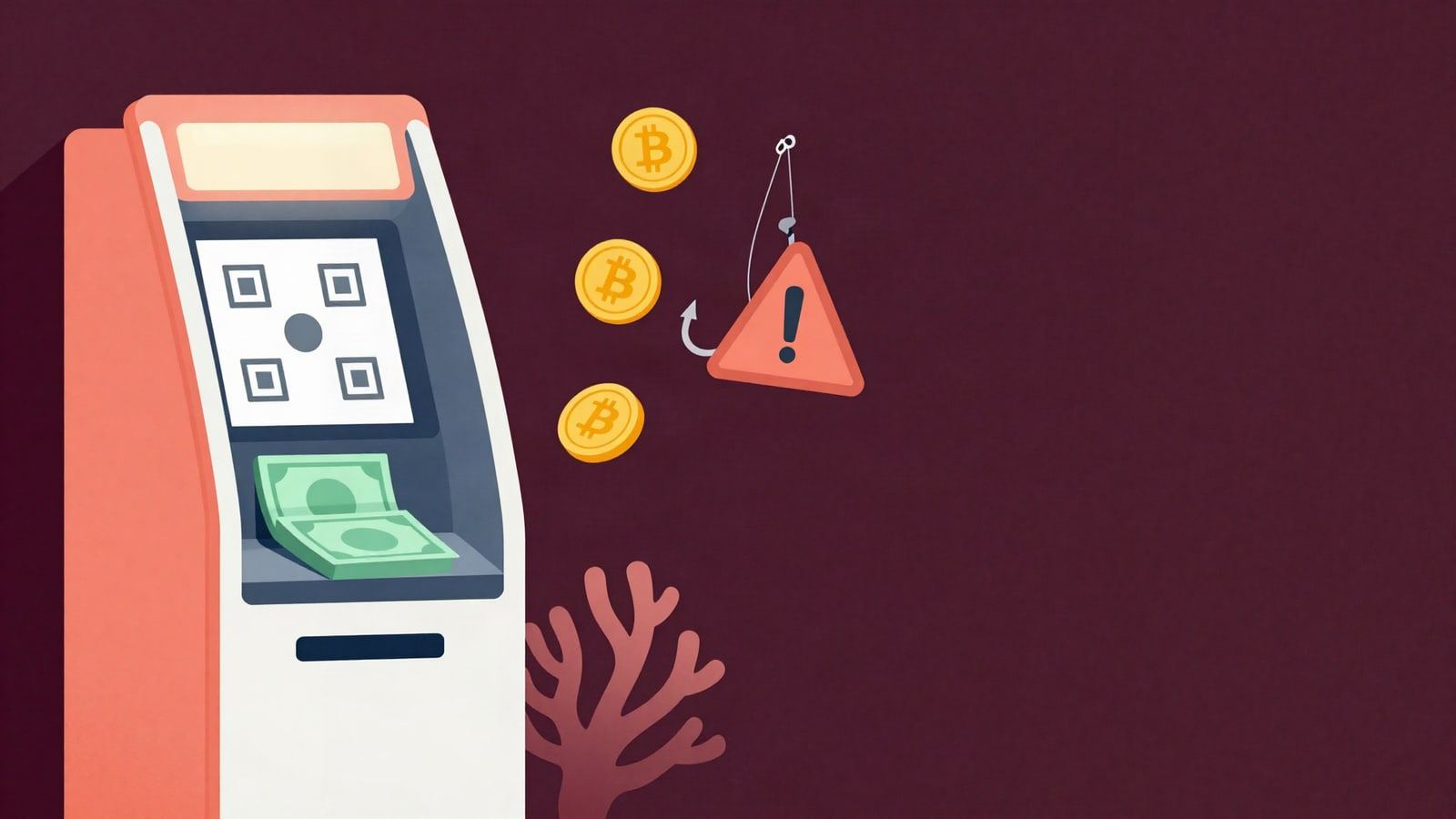
Here, crypto is just the payment rail. The scammer pretends to be a government agency, your bank, a tech support company or the police, and convinces you that your money is at risk or that you owe a fine. You’re told to withdraw cash and feed it into a crypto ATM (kiosk), often using a QR code the scammer sends, which delivers the crypto straight to their wallet. The FBI has issued specific warnings about schemes that use crypto ATMs and QR codes to collect payment.
No genuine government agency, bank or police force will ask you to pay them through a crypto ATM.
3. Recovery scams
After a loss, victims are often contacted by someone who promises to get the money back: a “law firm”, a “blockchain investigator”, sometimes someone pretending to be a government agency. The FBI has warned about fictitious law firms targeting crypto scam victims, and about scammers impersonating the IC3 itself. Recovery scams cost Americans $1.4 billion in 2025, although that figure may include losses from the original scam that led to the contact.
The pattern is always an upfront payment, a “fee”, a “tax” or a “deposit”, before the money is returned. It never is.
4. Fake platforms and impersonated firms
Some scams copy the name, logo and website design of a real exchange or a regulated investment firm. In the UK, the FCA warns about clone firms that use the name, address and registration number of genuine authorized firms. Always reach a firm through the contact details on the official register, not through a link or a phone number you were sent.
5. Romance and friendship scams
The relationship comes first, built over weeks or months, and the “investment opportunity” comes later. It’s often a form of investment fraud. If someone you’ve never met in person starts talking about crypto profits, treat it as a warning sign.
6. Giveaways, phishing and wallet drainers
Fake “send 1, get 2 back” giveaways, often using deepfake videos of famous people. Fake wallet support asking for your recovery phrase. Fake airdrop sites that ask you to “connect your wallet” and sign a transaction that empties it. Nobody legitimate will ever need your recovery phrase.
Warning signs
- Someone you don’t know contacts you first and steers the conversation toward investing.
- They move you quickly to WhatsApp, Telegram or another private app.
- Returns are guaranteed, unusually high or too smooth.
- The platform isn’t on your country’s official register: see how to check if a crypto exchange is registered.
- You’re asked to pay fees or taxes to withdraw your own money.
- You’re pressured to act fast, or told to keep it secret from your bank or family.
- Anyone asks for your recovery phrase or private keys.
- Anyone asks you to pay through a crypto ATM or a QR code.
If you’ve been scammed: what to do now
- Stop sending money. Including any “fees” to unlock withdrawals.
- Write everything down. Wallet addresses, transaction IDs (hashes), dates, amounts, website addresses, usernames, phone numbers and screenshots of chats.
- Contact your bank or card provider straight away if you paid from a bank account or card, and the exchange you sent the crypto from.
- Report it to the authorities below.
- Expect recovery scams. Be very wary of anyone who contacts you afterwards offering to get your money back for a fee.
Where to report
United States
- FBI Internet Crime Complaint Center: ic3.gov. This is the main channel for crypto fraud.
- Federal Trade Commission: ReportFraud.ftc.gov.
- Your local police, especially if you’re in immediate danger or the scammer is local.
United Kingdom
- England, Wales and Northern Ireland: Report Fraud, online or on 0300 123 2040. Report Fraud replaced Action Fraud as the national reporting service on 4 December 2025, and old Action Fraud links redirect to it.
- Scotland: call Police Scotland on 101.
- If the scam involved a firm pretending to be authorized, you can also tell the FCA.
Canada
- Your local police.
- The National Cybercrime and Fraud Reporting System at reportcyberandfraud.canada.ca, launched by the RCMP in November 2025. The RCMP says it doesn’t replace existing channels, so report to your local police as well.
- The Canadian Anti-Fraud Centre by phone at 1-888-495-8501.
- If a crypto platform was involved, check the CSA’s list of banned platforms and tell your provincial securities regulator.
Can the money be recovered?
Sometimes, but rarely in full. Crypto transfers can’t be reversed by the sender, so recovery depends on investigators tracing the funds to an exchange that can freeze them, quickly. That’s why fast reporting with full transaction details matters. And it’s why nobody can honestly guarantee to recover your crypto for a fee: anyone who does is very likely running the next scam.
Sources
- 2025 IC3 Annual Report (Internet Crime Report) — Federal Bureau of Investigation, Internet Crime Complaint Center
- FTC testifies before the Joint Economic Committee on agency's efforts to combat fraud — Federal Trade Commission
- Report Fraud service goes live — Report Fraud (City of London Police)
- Report Fraud: new service from City of London Police — GOV.UK
- Top 10 frauds in 2025 — Canadian Anti-Fraud Centre
- RCMP launches new National Cybercrime and Fraud Reporting System — Royal Canadian Mounted Police
- Crypto Platforms: Regulation and Enforcement Actions — Canadian Securities Administrators
- How to check a firm or individual is authorised — Financial Conduct Authority
First published . Spotted an error or an outdated figure? Tell us and we will check it against the source.