Bitcoin ATMs: how they work, what they cost, and why scammers love them
How crypto ATMs (kiosks) work, the official loss figures from the FBI and FTC, the scam scripts that send victims to them, and the rules in the US, UK and Canada.
Figures checked against 6 official and primary sources on . See the sources · How we check
Key points
- A bitcoin ATM (crypto kiosk) turns cash into crypto sent to a wallet address, usually by scanning a QR code. Once sent, it can't be reversed.
- In 2025 the FBI received 13,460 complaints involving crypto ATMs, with $389 million in losses. People aged 60 and over reported $257 million of that.
- Scammers impersonating government agencies, banks and tech support tell victims to withdraw cash and feed it into a crypto ATM.
- In the UK, no crypto ATM operator is registered with the FCA, so any operating there are doing so illegally.
- No genuine agency, bank or police force will ever ask you to pay through a crypto ATM.
In this guide
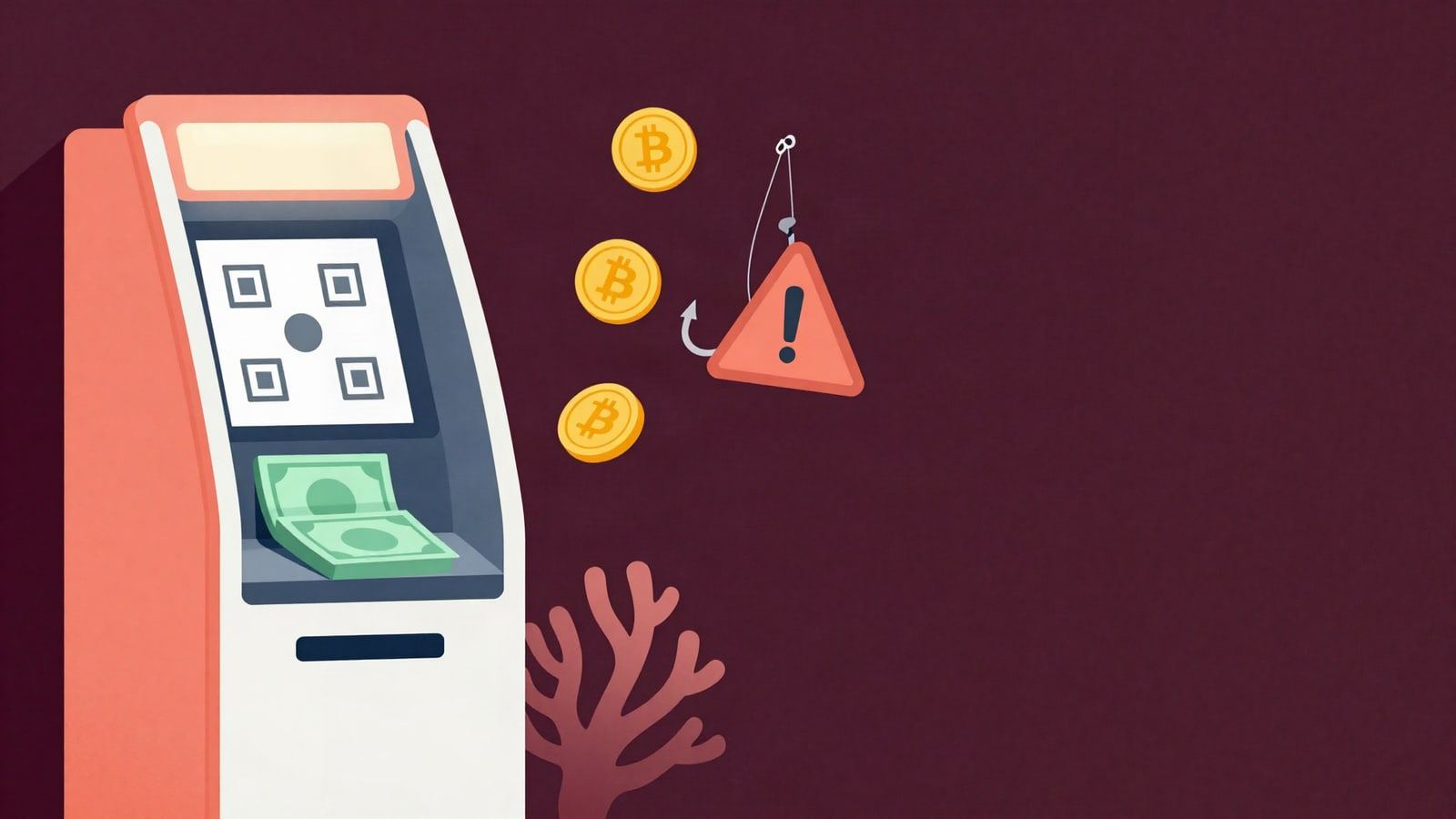
You may have seen them in convenience stores, gas stations or shopping malls: machines that look like cash machines but sell bitcoin. Insert cash, scan a wallet’s QR code, and the crypto is sent within minutes.
For some people they’re a quick way to buy small amounts with cash. For fraudsters, they’ve become one of the most effective ways to take money from victims, because the payment is instant, cash-funded and irreversible. This guide explains how they work and the warning signs.
How a crypto ATM works
- You choose the coin and the amount on the machine’s screen.
- You may need to verify your identity, for example with a phone number, an ID document or a selfie, depending on the amount and the rules where the machine is.
- You scan the QR code of a wallet address. This is where the crypto will be sent.
- You insert cash. The machine sends crypto, minus its fees, to that address.
The crucial point is step 3. Whoever controls the wallet behind that QR code receives the money. If someone else gave you the QR code, the crypto goes to them, and there’s no bank to call to reverse it.
What they cost
Crypto ATMs are usually far more expensive than buying on an exchange. Costs come in several layers:
- A transaction fee, often a percentage of the amount.
- A markup on the exchange rate, so the price per coin is higher than on exchanges.
- Sometimes a flat fee per transaction, plus the network fee to send the crypto.
Machines usually show the rate before you confirm, but they don’t all present it the same way. Compare the total amount of crypto you’ll receive with what the same cash would buy on a registered exchange. For regular purchases, an exchange is almost always cheaper: see exchange fees explained.
Why scammers send people to crypto ATMs
The official numbers
- FBI (2025): the IC3 received 13,460 complaints involving crypto ATMs or kiosks, with $389 million in losses, up 23% in complaints and 58% in losses on 2024. People aged 60 and over accounted for 6,188 of those complaints and $257 million of the losses.
- FTC (2024): consumers reported losing more than $110 million to bitcoin ATM scams in 2023, nearly ten times the 2020 figure, and over $65 million in just the first half of 2024. People aged 60 and over reported $46 million of that, about 71%, and the median reported loss was $10,000.
The scripts
According to the FTC, most losses involving bitcoin ATMs come from three types of scam:
- Government impersonation: a caller claims you owe money or that your identity has been used in a crime, and tells you to “protect” or “pay” money through a crypto ATM.
- Business impersonation: someone posing as your bank or a well-known company says your account has been hacked and you need to move your money to a “safe” place.
- Tech support: a pop-up or caller says your computer is infected or your account has been breached, and asks for payment.
The pattern is the same: urgency, a reason you must withdraw cash, instructions to go to a specific machine, and a QR code sent by the scammer. Some scammers stay on the phone the whole time, telling victims what to say if anyone asks questions.
No genuine government agency, bank, police force or tech company will ever ask you to pay through a crypto ATM. If anyone does, it’s a scam.
The rules in the US, UK and Canada
- United States: crypto ATM operators are generally treated as money transmitters, registered with FinCEN and licensed by states. Some states have added rules for kiosks, such as transaction limits for new customers and fee caps, so the rules depend on where the machine is.
- United Kingdom: crypto ATMs must be registered with the FCA, and the FCA says none of the registered crypto firms is approved to offer crypto ATM services. Any crypto ATM operating in the UK is doing so illegally. The FCA has inspected sites, disrupted machines and brought criminal prosecutions against operators.
- Canada: operators of virtual currency ATMs are considered money services businesses and must register with FINTRAC. FINTRAC has published guidance on how these machines can be used to launder the proceeds of crime.
If you’ve already paid
- Stop all contact with the person who sent you there, and don’t send more money, whatever they say.
- Keep the receipt from the machine. It usually shows the wallet address and transaction details.
- Contact the ATM operator straight away, using the number on the machine or its official website. Ask whether the transaction can be stopped and report the wallet address.
- Report it to the police and your national fraud reporting service. In the US, also report to the FTC and the FBI’s IC3. See where to report crypto scams.
- Expect recovery scams. People who’ve lost money are often contacted by fake “recovery” services that charge an upfront fee. They’re scams too.
Protecting someone you care about
Older people are the main targets. Some simple conversations help:
- Agree that no genuine official will ever ask for payment in cash, gift cards or crypto.
- Agree on a family rule: before any unusual payment, call a family member first.
- Explain that scammers may say “don’t tell anyone, not even the bank”. That alone is a sign of a scam.
For a broader look at crypto fraud, see crypto scams: the most common types.
Sources
- 2025 IC3 Annual Report (Internet Crime Report) — Federal Bureau of Investigation, Internet Crime Complaint Center
- New FTC data shows massive increase in losses to Bitcoin ATM scams — Federal Trade Commission
- Bitcoin ATMs: a payment portal for scammers (Data Spotlight) — Federal Trade Commission
- Warning on illegal crypto ATMs operating in the UK — Financial Conduct Authority
- Check to see if you need to register with FINTRAC as a money services business — FINTRAC
- The role of virtual currency automated teller machines in laundering the proceeds of crime — FINTRAC
First published . Spotted an error or an outdated figure? Tell us and we will check it against the source.