Centralized vs decentralized exchanges (CEX vs DEX): how they really differ
Who holds your crypto, how trades are matched, what you pay in fees, how each can fail, and how regulators and tax authorities treat them.
Figures checked against 8 official and primary sources on . See the sources · How we check
Key points
- On a centralized exchange (CEX), a company holds your crypto and matches your orders. On a decentralized exchange (DEX), you trade from your own wallet through smart contracts.
- A CEX can fail as a company: insolvency, hacks or frozen withdrawals. A DEX shifts the risk to you: lost keys, malicious tokens and smart contract bugs.
- On Ethereum, you pay gas in ETH for every DEX transaction, even if it fails, and large trades can suffer slippage.
- For tax, a swap is a swap: in the US, UK and Canada, exchanging one crypto for another is a taxable disposal on either type of exchange.
In this guide
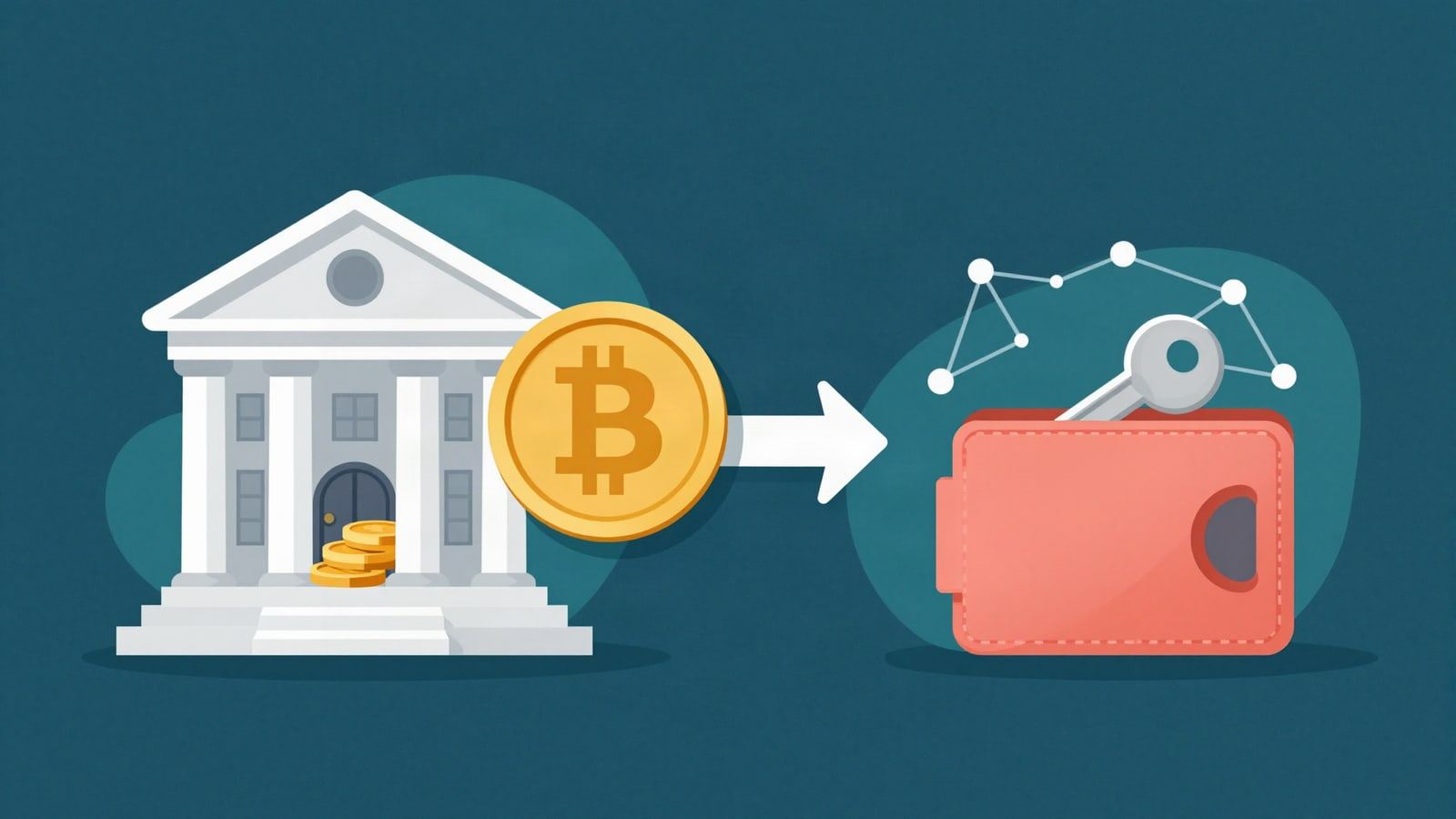
“Exchange” covers two very different things in crypto. A centralized exchange (CEX) is a company: you open an account, deposit money, and it holds your crypto and runs the marketplace. A decentralized exchange (DEX) is software running on a blockchain: there’s no account, you connect your own wallet, and trades settle directly on-chain.
Neither is “better” in general. They fail in different ways, cost different amounts, and put responsibility in different places. This guide compares them point by point.
The short version
| Centralized exchange (CEX) | Decentralized exchange (DEX) | |
|---|---|---|
| Who holds your crypto | The exchange (custodial) | You, in your own wallet (self-custody) |
| Account and ID checks | Yes: account, identity verification | No account; you connect a wallet |
| How prices are set | Order book: buyers’ and sellers’ orders are matched | Usually liquidity pools priced by a formula |
| Dollars, pounds or Canadian dollars | Deposit and withdraw directly | Not directly: crypto-to-crypto only |
| Main costs | Trading fees, spreads, withdrawal fees | Network (gas) fees, pool fees, slippage |
| Main risks | Company failure, hacks, frozen withdrawals | Lost keys, scam tokens, smart contract bugs, phishing |
| If something goes wrong | Customer support, regulators, insolvency process | Usually nobody can reverse a transaction |
Custody: whose crypto is it, in practice?
On a CEX, the crypto in your account is held by the exchange. You have a claim on the company, much like a balance at a payment app, but the coins sit in wallets the exchange controls. That’s convenient: you can reset a forgotten password, and you can sell straight into your bank account. It also means your access depends on the company staying solvent, honest and secure.
On a DEX, nothing is deposited with anyone. The crypto stays in your wallet until the moment a trade executes, and the result comes back to the same wallet. Nobody can freeze your account, but nobody can recover it either. If you lose your recovery phrase, or sign a malicious transaction, the loss is usually permanent.
How trades are matched
Centralized exchanges run an order book: a list of buy orders and sell orders at different prices. When a buyer’s price meets a seller’s price, the exchange matches them. You can choose order types, such as market, limit and stop orders, which are explained in our guide to crypto order types.
Most decentralized exchanges use liquidity pools instead. A pool holds two tokens, deposited by other users who earn a share of the trading fees. A formula sets the price based on the ratio of the two tokens in the pool. When you buy one token, you add the other to the pool, which moves the price. The bigger your trade relative to the pool, the more the price moves against you. This is called price impact or slippage.
What you pay
On a CEX, costs are usually:
- A trading fee, often a percentage of the trade, which may differ for orders that add liquidity (“maker”) and orders that take it (“taker”).
- The spread between buy and sell prices, especially on “instant buy” buttons.
- Withdrawal fees when you move crypto out.
On a DEX, costs are usually:
- Network fees. On Ethereum these are called gas and must be paid in ETH. According to the Ethereum documentation, the fee is paid whether the transaction succeeds or fails, so a failed swap still costs you.
- A pool fee that goes to liquidity providers.
- Slippage from price impact, plus the risk of being “sandwiched”. The Ethereum documentation explains that some bots place orders just before and just after large trades, and that users who are sandwiched face increased slippage and worse execution.
Small trades on a busy network can cost more in fees than they’re worth. Large trades on a shallow pool can lose more to slippage than to fees.
How each one can fail
Centralized exchange risks:
- Insolvency or fraud. If the company collapses, customers may wait years, through an insolvency process, to recover some of their money, or recover nothing.
- Hacks. Exchanges hold large amounts of crypto in one place, which makes them targets.
- Frozen withdrawals. An exchange can pause withdrawals during a crisis, a regulatory action or an investigation.
- Weak or no regulation. The CFTC warns that most crypto cash markets aren’t regulated or supervised by a government agency and may lack critical safeguards, including customer protections.
Decentralized exchange risks:
- Key loss. Lose your recovery phrase and you lose the wallet.
- Phishing and malicious approvals. Fake DEX websites and fake “airdrop claim” pages ask you to sign transactions that let them drain your wallet.
- Scam tokens. Anyone can create a token and a pool for it. Tokens can be copies of well-known names, or be designed so that you can buy but not sell.
- Smart contract bugs. A flaw in the code can be exploited, and there’s usually no one to compensate users.
Regulation and protection
Centralized exchanges are businesses, so they fall under financial regulators where they serve customers:
- In the UK, crypto businesses must be registered with the FCA, but registration doesn’t bring Financial Ombudsman or FSCS protection.
- In Canada, crypto trading platforms must be registered with provincial or territorial securities regulators. The CSA warns that platforms that don’t comply with Canadian securities law present significant risks because customers’ assets may not be adequately safeguarded.
- In the US, exchanges register with FinCEN and need state licenses.
Our guide on how to check if a crypto exchange is registered shows exactly where to look.
A DEX has no customer relationship with you, so there’s usually no register to check, no complaints process and no compensation scheme. That freedom is the point of a DEX, and also its main risk for beginners.
Taxes: the same on both
Tax authorities don’t care which kind of exchange you used. What matters is the transaction:
- US: the IRS says exchanging digital assets for other digital assets results in a capital gain or loss. Moving crypto between your own wallets isn’t taxable, except for crypto used to pay fees.
- UK: HMRC lists exchanging one cryptoasset for a different one as a disposal for Capital Gains Tax.
- Canada: the CRA treats trading one crypto-asset for another as a disposition.
The practical difference is record-keeping. A CEX gives you a transaction export. On a DEX, your history is public on the blockchain but scattered across transactions, so keep your own records as you go. See our tax guides for the US, the UK and Canada.
Which should you use?
- If you’re buying crypto with dollars or pounds for the first time, a registered centralized exchange is the usual starting point, because it connects to your bank and has a regulator and a complaints process. Check its registration first.
- If you already hold crypto in your own wallet and understand transaction signing, gas fees and token approvals, a DEX lets you trade without handing your crypto to a company.
- Whichever you use, don’t leave more on any platform than you can afford to lose, and never type your recovery phrase into a website.
Sources
- Crypto Platforms: Regulation and Enforcement Actions — Canadian Securities Administrators
- Cryptoassets: AML / CTF regime — Financial Conduct Authority
- Customer Advisory: Understand the Risks of Virtual Currency Trading — Commodity Futures Trading Commission
- Gas and fees — ethereum.org (Ethereum documentation)
- Maximal extractable value (MEV) — ethereum.org (Ethereum documentation)
- Frequently asked questions on digital asset transactions (FAQs 64 and 81) — Internal Revenue Service
- Check if you need to pay tax when you sell cryptoassets — HM Revenue & Customs (GOV.UK)
- Understanding crypto-assets and your tax obligations — Canada Revenue Agency
First published . Spotted an error or an outdated figure? Tell us and we will check it against the source.