What is a layer 2? Rollups explained, and why they make Ethereum cheaper
What layer 2 networks are, how optimistic and zero-knowledge rollups work, why fees are lower, the week-long withdrawal wait and the risks to check first.
Figures checked against 7 official and primary sources on . See the sources · How we check
Key points
- A layer 2 is a separate network that handles transactions off Ethereum's main chain and then settles them on Ethereum, so each user pays a share of one transaction.
- Most are rollups. Optimistic rollups assume transactions are valid unless challenged; zero-knowledge rollups post a proof that they are.
- Withdrawing from an optimistic rollup back to Ethereum means waiting out a challenge period of roughly seven days, unless you pay a liquidity provider.
- ethereum.org says no layer 2 is as battle-tested as Ethereum itself. Start small, and check the network's technology and maturity.
In this guide
If you’ve ever been quoted a fee of several dollars to move a token on Ethereum, you’ve met the problem that layer 2 networks are built to solve. ethereum.org’s own layer 2 page advertises fees of around $0.01 and transactions that take a few seconds.
This guide explains what layer 2 means, how rollups work, why they’re cheaper, what’s different about withdrawing, and the risks to keep in mind.
Layer 1 and layer 2
Layer 1 is the base blockchain itself: Ethereum’s main network, with its validators, its blocks and its history. ethereum.org describes it as the foundation that layer 2 projects build on.
A layer 2 is, in ethereum.org’s words, a collective term for scaling solutions that handle transactions off Ethereum layer 1 while still taking advantage of its decentralized security. Examples include zero-knowledge rollups and optimistic rollups on Ethereum, and the Lightning Network on top of bitcoin.
Why layer 2 exists
ethereum.org explains the problem with the blockchain trilemma: a simple blockchain design can only achieve two of three properties, being decentralized, secure and scalable. Ethereum chose decentralization and security. As demand grew, the network hit its capacity, and fees rose: when demand is high, congestion pushes fees up and prices some people out. See Ethereum gas fees explained.
Ethereum can’t simply make its main chain much bigger and faster, ethereum.org says, because it needs to stay secure and decentralized. Layer 2 is the community’s answer: keep the base layer robust, and do most of the work on top.
How rollups work
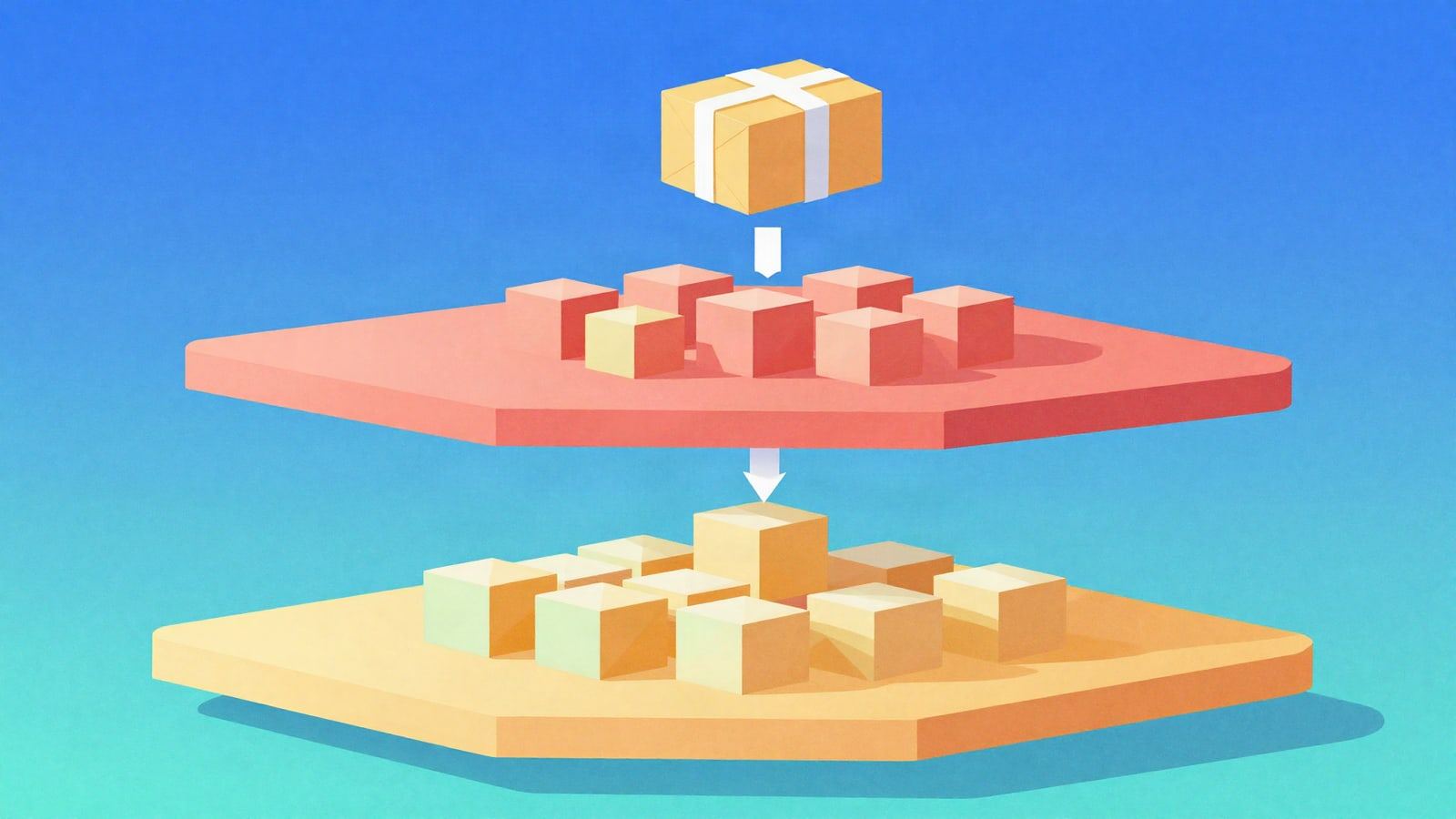
Most layer 2s on Ethereum are rollups. According to ethereum.org, a rollup executes transactions outside layer 1, then posts the data to layer 1, where consensus is reached. Because the transaction data ends up in Ethereum blocks, rollups can rely on Ethereum’s security.
The key to lower fees is batching: rollups combine many transactions into a single transaction on layer 1, so the cost of that one transaction is shared among everyone in the batch.
ethereum.org also offers a simple test for whether a network is really part of Ethereum: does it store its data on Ethereum’s main network? Projects that do are what are usually called rollups. If the data is stored somewhere else, the network is more independent.
Optimistic vs zero-knowledge rollups
There are two main types, and they differ in how they prove that the transactions they post are correct.
| Optimistic rollups | Zero-knowledge (ZK) rollups | |
|---|---|---|
| Approach | Assume transactions are valid by default | Compute off-chain and submit a proof of validity |
| How errors are caught | Anyone can challenge a batch during a challenge period using a fault proof | The validity proof is checked on Ethereum |
| Withdrawal to Ethereum | Wait for the challenge period, roughly seven days | No challenge delay: exits are executed once the proof is verified |
Optimistic rollups, ethereum.org explains, rely on a fraud-proving scheme. After a batch is submitted, there’s a window during which anyone can challenge it. If the challenge succeeds, the rollup re-executes the transactions and corrects its state, and the operator that included the bad transaction is penalized. If nobody challenges it in time, the batch is accepted.
Zero-knowledge rollups use validity proofs: they compute transactions off-chain and send Ethereum a cryptographic proof that the results are correct. ethereum.org says there are no delays when moving funds from a ZK-rollup to Ethereum, because exits are executed once the rollup’s contract verifies the proof.
The week-long withdrawal
This is the part that surprises new users. ethereum.org says that if you withdraw from an optimistic rollup back to Ethereum, you must wait until the challenge period, lasting roughly seven days, has passed.
There’s a workaround: a liquidity provider can take over your pending withdrawal and pay you on Ethereum straight away, in exchange for a fee. Many bridges and wallets offer this. See crypto bridges explained.
Moving funds into a rollup, or between accounts on the same rollup, doesn’t involve this wait.
Why fees fell further in 2024
On 13 March 2024, Ethereum’s Dencun upgrade went live. ethereum.org says it included EIP-4844, known as proto-danksharding, which introduced data “blobs” that let rollups post data to the main network for a short period at much lower cost. The result, according to ethereum.org: significantly lower transaction fees for layer 2 users.
What you’re paying for on a rollup
ethereum.org breaks a rollup transaction fee into parts:
- State write: the cost of publishing the rollup’s compressed transaction data to Ethereum. Since Dencun this is usually posted as blobs, which, unlike permanent transaction data, are pruned from nodes after 4,096 epochs, about 18 days.
- Blob gas: blobs have their own fee market, similar to the one for ordinary gas, with a base fee that rises and falls with demand for blob space.
- L2 operator fees: what the rollup’s own nodes charge to process your transaction, usually low because they aren’t competing for space in congested Ethereum blocks.
That’s why the cost of using a rollup depends partly on demand for blob space on Ethereum, not just on the rollup itself.
Pectra and Fusaka: more room for rollups
Later upgrades kept adding capacity for layer 2 data:
- Pectra (May 2025) raised the target number of blobs per block from 3 to 6, according to ethereum.org.
- Fusaka (December 2025) introduced PeerDAS, which lets each full node store only about an eighth of the blob data, enabling a theoretical eightfold scale-up, plus Blob-Parameter-Only forks to raise blob capacity between major upgrades.
See Ethereum’s upgrades explained.
Who orders the transactions?
Most rollups rely on an operator, often called a sequencer, to collect transactions, order them and post batches to Ethereum. ethereum.org explains that this creates a dependency:
- A rollup operator could censor users, by going offline or refusing to include certain transactions, or try to block withdrawals by withholding data.
- Rollups counter this by publishing their data to Ethereum, so another node can rebuild the state and users can prove what they own and withdraw.
- On optimistic rollups, users can also submit transactions on Ethereum itself instead of to the sequencer, which must then include them within a time limit.
These protections depend on each rollup’s design, which is one reason ethereum.org suggests checking how mature a network is before using it.
The risks
ethereum.org is direct about the trade-offs:
- Maturity. Many layer 2 technologies only went live in 2021. ethereum.org stresses this doesn’t mean they’re insecure, only that no layer 2 is as battle-tested as Ethereum Mainnet.
- Network-specific safety. The safety of each network depends on its technology, smart contract security and maturity. Rollups are managed by smart contracts on Ethereum, so a bug in them is a risk. See what is a smart contract?
- Not all “Ethereum networks” are equal. ethereum.org notes that many networks claim to scale Ethereum to gain popularity. Sidechains and validiums run alongside Ethereum and connect through bridges, but they derive their security differently.
- Wrong-network mistakes. The same address can exist on several networks. Sending to an exchange or wallet on a network it doesn’t support can leave funds stuck. See how to send crypto safely.
ethereum.org’s advice is to do your own due diligence, start with small transactions and stay up to date. It also points users to L2BEAT, an independent site that assesses the technology and risks of each layer 2.
How to start using a layer 2 safely
- Check that your wallet supports the network, and add it from a trusted source, not a link in a message.
- Fund it the simple way first. If your exchange supports withdrawals on the layer 2 you want, that can avoid using a bridge. Confirm the network on both sides.
- Send a small test amount before moving larger sums.
- Check which token the network uses for fees, and keep a little of it for transactions.
- Plan withdrawals from optimistic rollups with the seven-day wait in mind.
For more on how Ethereum works underneath, see what is Ethereum? and bitcoin vs Ethereum.
Frequently asked questions
Is a layer 2 a different cryptocurrency?
Can I send tokens from a layer 2 directly to an exchange?
Why do I have to wait a week to withdraw?
Is the Lightning Network a layer 2?
Sources
- Layer 2 — ethereum.org (Ethereum documentation)
- What is layer 2? — ethereum.org (Ethereum documentation)
- Scaling — ethereum.org (Ethereum documentation)
- Optimistic rollups — ethereum.org (Ethereum documentation)
- Zero-knowledge rollups — ethereum.org (Ethereum documentation)
- The history of Ethereum (Cancun-Deneb upgrade) — ethereum.org (Ethereum documentation)
- Fusaka — ethereum.org (Ethereum documentation)
First published . Spotted an error or an outdated figure? Tell us and we will check it against the source.


